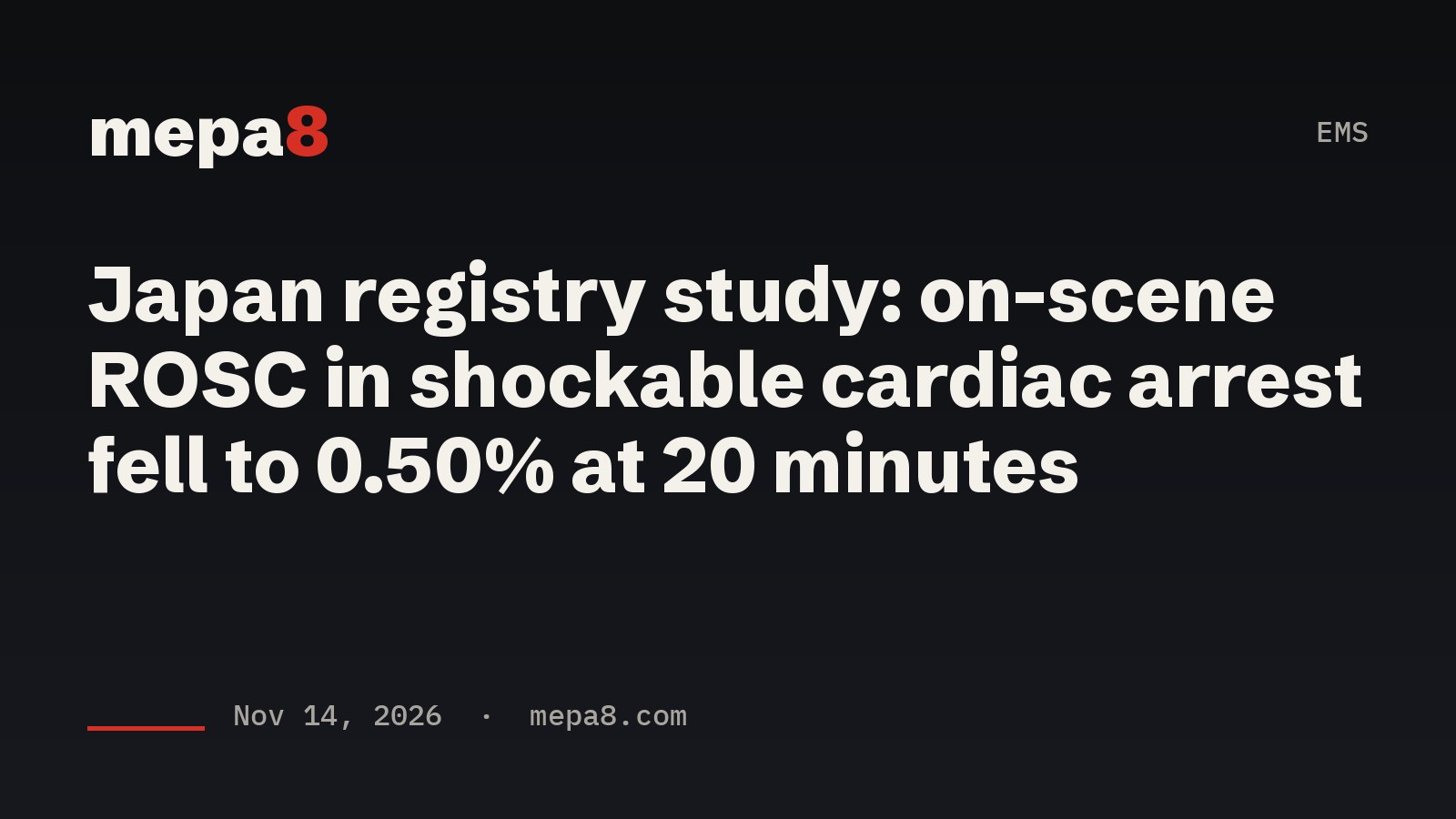
Japan registry study: on-scene ROSC in shockable cardiac arrest fell to 0.50% at 20 minutes
Among patients who regained a pulse at or after 10 minutes, 50.0% of those younger than 75 had a favorable neurological outcome, compared with 20.5% of older patients.
Key takeaways
- A nationwide Japanese registry study of 22,383 adults with cardiogenic cardiac arrest and an initial shockable rhythm was published November 14, 2026 in the Journal of Clinical Medicine.
- Among patients still in arrest at 10 minutes after EMS contact, 6.97% went on to achieve on-scene ROSC; at 20 minutes, the figure was 0.50%.
- Overall, 5095 patients achieved on-scene ROSC and 3182 had a favorable neurological outcome at 1 month.
- Among patients who achieved ROSC at or after 10 minutes, favorable outcomes were seen in 50.0% of those younger than 75 and 20.5% of those 75 or older.
- For crews: the data come from Japanese EMS practice in 2017-2022, and the authors stated the age findings do not set criteria for prolonged resuscitation or transport decisions.
A nationwide study of Japanese cardiac arrest records, published November 14, 2026 in the Journal of Clinical Medicine, found that the chance of regaining a pulse on scene fell steeply as EMS resuscitation time went on for adults whose arrest began in a shockable rhythm [1]. Among patients still in arrest 10 minutes after EMS contact, 6.97% went on to achieve on-scene return of spontaneous circulation (ROSC). At 20 minutes, that figure was 0.50% [1].
The retrospective cohort drew on linked Japanese Utstein registry and emergency transport data from 2017-2022, according to the PubMed abstract [1]. It included 22,383 adults with cardiogenic out-of-hospital cardiac arrest (OHCA) and an initial shockable rhythm. The authors, with Miyazaki K listed first, set out to describe time-dependent patterns "under existing Japanese emergency medical services (EMS) practice" [1].
The study also found that among patients who regained a pulse later in the resuscitation, younger adults more often survived with good neurological function. The authors cautioned that this result does not set age cutoffs for field decisions [1].
What the records show
The study was a nationwide retrospective descriptive cohort, according to the abstract [1]. For each time point after EMS contact, the researchers calculated the observed probability that a patient still in arrest would later achieve ROSC on scene. Among patients who did achieve on-scene ROSC, they then calculated the probability of a favorable neurological outcome, defined as CPC 1-2 at 1 month, grouped by when ROSC occurred [1].
Of the 22,383 eligible patients, 5095 achieved on-scene ROSC and 3182 had favorable neurological outcomes [1]. The abstract reports two time points for subsequent on-scene ROSC:
| Time after EMS contact | Probability of subsequent on-scene ROSC | Patients (ROSC / still in arrest) | 95% CI |
|---|---|---|---|
| 10 min | 6.97% | 1295/18,583 | 6.61-7.34% |
| 20 min | 0.50% | 87/17,375 | 0.41-0.62% |
Neurological outcomes differed by age. Among patients who achieved on-scene ROSC at or after the 10-minute mark, favorable outcomes occurred in 50.0% of those younger than 75 and in 20.5% of those 75 or older [1].
The researchers also ran a sensitivity analysis limited to 3128 patients whose first EMS defibrillation came within 1 min. That subgroup showed what the authors called "broadly similar temporal patterns" [1].
The authors concluded that under Japanese EMS practice, both on-scene ROSC and favorable neurological outcomes became less common the later ROSC occurred [1].
Why it matters for EMS
On every arrest call, crews face the question of how likely a pulse is to come back if it has not returned yet. This study gives observed, minute-by-minute registry figures for that question in one national system, restricted to adults with cardiogenic arrest and a shockable first rhythm [1]. Between the 10-minute and 20-minute marks, the reported probability of later on-scene ROSC dropped from 6.97% to 0.50% [1].
The neurological data add another layer. Patients who regained a pulse at or after 10 minutes still had favorable outcomes in a share of cases, and that share was higher among patients younger than 75 [1]. The authors addressed how these numbers might be used, writing that "these findings do not establish age-based criteria for prolonged resuscitation or transport decisions" [1].
The authors framed every result as describing existing Japanese EMS practice [1]. EMS clinicians elsewhere work under local protocols and medical direction, and resuscitation and transport practices differ between systems.
What the records do not tell us
- The packet contains only the abstract. The full paper's methods, tables and limitations section were not reviewed for this report.
- The abstract gives ROSC probabilities only at 10 and 20 minutes. It does not report figures for other time points, and it gives neurological outcome percentages by age only for the 10-minute mark.
- The study is descriptive and observational. It reports observed frequencies, not the effect of any treatment or of continuing versus stopping resuscitation.
- The abstract does not describe which interventions patients received, such as medications, airway management or mechanical CPR, or how long transport took.
- The abstract does not report outcomes for patients who regained a pulse after leaving the scene, since its main measure was on-scene ROSC.
- The abstract does not define exactly how "EMS contact" was timed in the registry.
- The data are from Japan only. The records contain no US or other national data for comparison.
- Funding sources and author conflicts of interest are not stated in the packet.
Questions readers ask
How likely is ROSC after 20 minutes of resuscitation in shockable cardiac arrest?
In a Japanese national registry study published November 14, 2026, 0.50% of patients still in arrest at 20 minutes after EMS contact went on to achieve on-scene ROSC (87/17,375). At 10 minutes, the figure was 6.97%.
Does age affect neurological outcome after late ROSC in cardiac arrest?
In the study, among patients who achieved on-scene ROSC at or after 10 minutes, favorable neurological outcomes occurred in 50.0% of those younger than 75 and 20.5% of those 75 or older. The authors wrote that the findings do not establish age-based criteria for prolonged resuscitation or transport decisions.
What data did the Japanese Utstein cardiac arrest study use?
It used linked Japanese Utstein and emergency transport data from 2017-2022. It included 22,383 adults with cardiogenic out-of-hospital cardiac arrest and an initial shockable rhythm.
How was favorable neurological outcome defined in the study?
The study defined a favorable neurological outcome as CPC 1-2 at 1 month. Overall, 3182 patients had a favorable outcome.
Sources
- Miyazaki K, et al. On-Scene Time-Dependent Probabilities of ROSC and Favorable Neurological Outcome in OHCA with an Initial Shockable Rhythm. Journal of Clinical Medicine (PubMed) (2026-11-14). pubmed.ncbi.nlm.nih.gov/43030628/
This is news, not medical advice. EMS clinicians: follow your local protocols and medical direction.