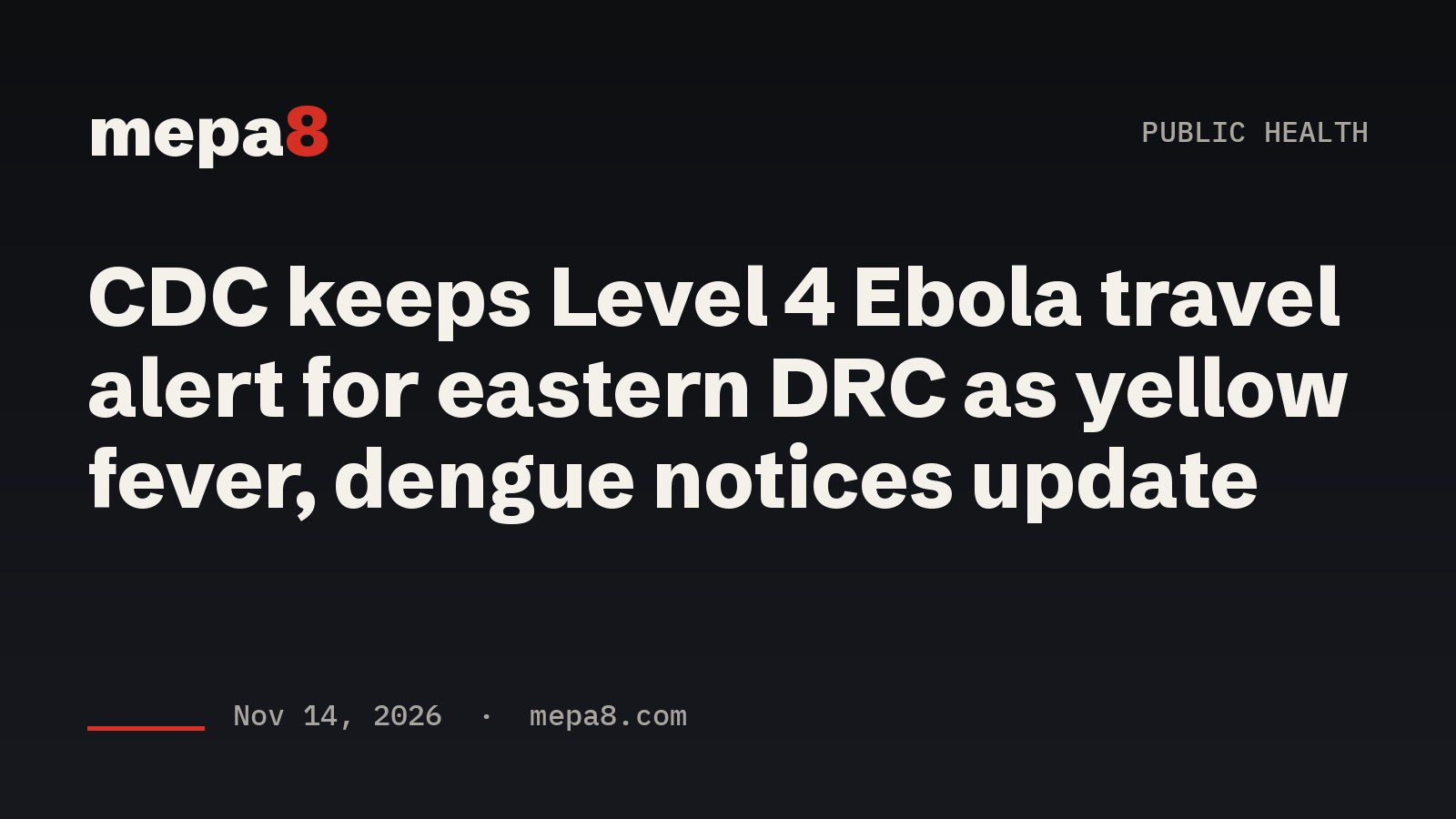
CDC keeps Level 4 Ebola travel alert for eastern DRC as yellow fever, dengue notices update
The Bundibugyo Ebola notices now step down from Level 4 in Ituri and Nord-Kivu to Level 1 in Kenya, where Nairobi health officials confirmed an imported case.
Key takeaways
- CDC's Level 4 "Avoid All Travel" notice covers Ituri and Nord-Kivu provinces of the DRC because of a Bundibugyo virus disease (Ebola) outbreak; it was posted August 04, 2026.
- The Ebola notices are tiered: Level 3 for Haut-Uélé and Tshopo, Level 2 for Uganda and DRC provinces outside the outbreak area, and Level 1 for Kenya.
- Kenya's Ministry of Health confirmed an imported Bundibugyo Ebola case and other linked cases in Nairobi, according to the CDC notice dated October 19, 2026.
- CDC updated its yellow fever notice for regions of Burkina Faso, Côte d'Ivoire and Ghana on November 09, 2026 and its global dengue notice on November 10, 2026.
- For crews: the European Medical Journal summary says the Bundibugyo incubation period extends up to 21 days and no licensed vaccine exists for that species.
The Centers for Disease Control and Prevention updated its global dengue travel notice on November 10, 2026, and its yellow fever notice for parts of Burkina Faso, Côte d'Ivoire and Ghana on November 09, 2026, according to the agency's Travel Health Notices page [1]. The same page still carries its highest alert, a Level 4 "Avoid All Travel" notice for Ituri and Nord-Kivu provinces of the Democratic Republic of the Congo (DRC), where an outbreak of Bundibugyo virus disease, a form of Ebola, is under way [1].
The Ebola notices are now tiered across the DRC, Uganda and Kenya, the CDC record shows [1]. A European Medical Journal (EMJ) summary published November 14, 2026 pointed to those tiers for U.S. clinicians who see patients before international trips or who evaluate travelers coming home with fever [2].
The page says CDC posts these notices to tell travelers about health risks tied to outbreaks, special events or gatherings, and natural disasters [1]. The notices are sorted into four levels, from Level 1, "Practice Usual Precautions," to Level 4 [1].
What the records show
Ebola (Bundibugyo virus disease)
| Level | Area | Notice date |
|---|---|---|
| Level 4 – Avoid All Travel | Ituri and Nord-Kivu provinces, DRC | August 04, 2026 (new) |
| Level 3 – Reconsider Nonessential Travel | Haut-Uélé and Tshopo provinces, DRC | August 04, 2026 (updated) |
| Level 2 – Practice Enhanced Precautions | Uganda and DRC provinces outside the outbreak area | August 28, 2026 (updated) |
| Level 1 – Practice Usual Precautions | Kenya | October 19, 2026 (new) |
The Level 4 notice makes an exception for people traveling for humanitarian aid or emergency response, according to the CDC record [1]. The Kenya notice says the Kenyan Ministry of Health confirmed an imported case of Bundibugyo Ebola in Nairobi, along with other linked cases [1].
Other Level 2 notices
- Yellow fever, West Africa (November 09, 2026): outbreaks in the Nando Region of Burkina Faso, the Bounkani Region of Côte d'Ivoire and the Upper West Region of Ghana. CDC lists vaccination at least 10 days before travel and mosquito-bite prevention [1].
- Yellow fever, Colombia (October 16, 2026): more cases than usual reported [1].
- Global polio (September 23, 2026): the destination list includes Germany, Israel, the West Bank and Gaza, and the United Kingdom, along with many countries in Africa and Asia [1].
- Chikungunya: Nicaragua (September 03, 2026), northwest Costa Rica (July 30, 2026) and French Guiana (June 04, 2026) [1].
- Zika, Indonesia (August 07, 2026): cases reported in travelers returning from Bali [1].
- Malaria: Yemen (June 11, 2026), including areas previously considered low-risk, and Mayotte (June 02, 2026) [1].
- Meningococcal disease, DRC (March 24, 2026): an outbreak in the Mangembo Health Zone of Kongo Central Province [1].
Level 1 notices
- Global dengue (November 10, 2026): CDC describes dengue as a year-round risk in many regions, with outbreaks commonly every 2–5 years [1].
- Hepatitis A: Costa Rica (September 18, 2026), with most cases in San José province, and Manitoba, Canada (June 04, 2026) [1].
- Paratyphoid fever, Yemen (August 26, 2026): cases in returning travelers [1].
- Diphtheria: several countries in sub-Saharan Africa (August 25, 2026) and Haiti (June 25, 2026) [1].
- Rocky Mountain spotted fever, Mexico (December 23, 2025): illness and death reported in northern Mexico along the U.S. border, particularly Baja California, Sonora, Chihuahua, Coahuila and Nuevo León [1].
- Global measles (May 28, 2025): CDC says cases are rising in many countries [1].
Why it matters for clinicians
The EMJ summary stated that no licensed vaccine exists for the Bundibugyo Ebola species and that its incubation period extends up to 21 days [2]. As a result, the journal wrote, travelers without symptoms may pass port-of-entry screening and only later develop fever [2]. The authors wrote that physicians "must obtain detailed 21-day travel histories" from febrile patients and isolate suspected cases using viral hemorrhagic fever personal protective equipment [2]. EMS clinicians follow local protocols and medical direction on screening and isolation.
Several notices touch places with heavy U.S. travel. The Rocky Mountain spotted fever notice covers Mexican states that border the United States, and the polio destination list includes Germany and the United Kingdom [1]. The Zika notice concerns Bali, and both the chikungunya and hepatitis A notices cover parts of Costa Rica [1]. EMJ also flagged the yellow fever, polio, hepatitis A, chikungunya and dengue notices as relevant to counseling before departure [2].
Context
The Ebola notices have widened over time on the CDC page. The Level 4 and Level 3 notices for DRC provinces both carry August 04, 2026 dates; the Level 2 notice covering Uganda and the rest of the DRC was updated August 28, 2026; and the Level 1 notice for Kenya followed on October 19, 2026 [1]. Some notices on the page are older, including the measles notice from May 2025 and the Mexico spotted fever notice from December 2025 [1].
What the records do not tell us
The CDC page does not give case counts, deaths or growth rates for any outbreak, including the Ebola outbreak in the DRC and the linked cases in Nairobi [1]. It does not say whether any related cases have been found in the United States. The page itself carries no overall publication date; the dates cited here belong to individual notices. The statements on vaccine availability and incubation period come from the EMJ summary, a secondary source, not from the CDC page text in the packet [2]. Neither record includes guidance written specifically for prehospital crews.
Questions readers ask
Where does the CDC say to avoid all travel because of Ebola?
CDC's Level 4 notice, dated August 04, 2026, covers Ituri and Nord-Kivu (North-Kivu) provinces of the Democratic Republic of the Congo. It exempts people traveling for humanitarian aid or emergency response.
Is there an Ebola travel notice for Kenya?
Yes. CDC posted a Level 1 notice on October 19, 2026 after Kenya's Ministry of Health confirmed an imported Bundibugyo Ebola case and other linked cases in Nairobi.
Is there a vaccine for Bundibugyo Ebola?
According to the European Medical Journal summary, no licensed vaccine exists for the Bundibugyo Ebola species. The journal also reported an incubation period of up to 21 days.
Which countries are in the CDC yellow fever travel notice?
The November 09, 2026 Level 2 notice covers the Nando Region of Burkina Faso, the Bounkani Region of Côte d'Ivoire and the Upper West Region of Ghana. A separate Level 2 notice covers Colombia.
Sources
- CDC — Travel Health Notices — wwwnc.cdc.gov. wwwnc.cdc.gov/travel/notices
- European Medical Journal — CDC Travel Health Notices: Key Outbreak Alerts for Clinicians (November 14, 2026) (2026-11-14). emjreviews.com/microbiology-infectious-diseases/news/cdc-travel-health
This is news, not medical advice. EMS clinicians: follow your local protocols and medical direction.